Discovering the Michael Chekhov Technique: In the Studio with Ted Pugh & Fern Sloan
by Danielle Carter
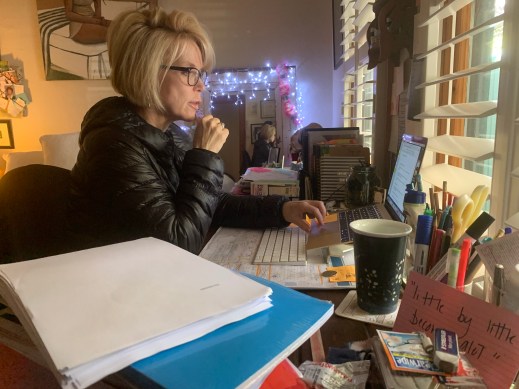
Drawing from 40 years of work with Michael Chekhov’s legacy, Fern Sloan and Ted Pugh are sharing their life’s work as practitioners, performers and teachers of the Michael Chekhov Technique. The book is being written by Danielle Carter, actress & author of “Racing Against Time”.
(Audio-Podcast: Danielle Carter is speaking about The Michael Chekhov Diaries. Subscribe on iTunes)
EXCERPT from
Discovering the Michael Chekhov Technique
Foreword by Joanna Merlin
This book is a gift to all those interested in exploring the Michael Chekhov technique. It is
filled with the advice, lessons and wisdom of Fern Sloan and Ted Pugh, two great teachers of
the Michael Chekhov technique. Great teachers are rare. They love what they’re teaching.
They never stop learning, exploring and experimenting. They raise the bar. They inspire.
I first met Ted and Fern in the 1980s when I taught at the Michael Chekhov Studio in New
York City. It is my good fortune to have been their close friend and colleague since that
time. They were part of the founding faculty of the Michael Chekhov Association (MICHA).
Their experiential teaching has enriched our work in immeasurable ways since MICHA’s
inception.
As the last surviving student of Michael Chekhov, I feel that Fern and Ted embody Chekhov’s
spirit and psycho-physical approach. In addition to being artists in the deepest sense, they
are visionary, generous, open and exuberant. They are beloved by their students and all
who know them. They have been working together as a team for so many years that they
form their own ensemble, bonded yet separate in their embrace of the process.
The Chekhov work continues to excite them, which radiates to their students. Though they
are in their eighties, their dedicated practice has allowed them to maintain their physical
strength and abilities. They move as though they were still young, an amazing phenomenon
to behold!
The Michael Chekhov School in Hudson, upstate New York was the brilliant idea of Ted Pugh
and Fern Sloan together with Ragnar Freidank. The school has flourished since they opened
the doors. Actors, teachers and students come from all over the world to study with these
actors. Some participants have translated Michael Chekhov’s books into their own language
as a result of Ted, Fern and Ragnar’s inspired teaching.
Danielle Carter met Fern and Ted at MICHA’s annual workshop in Connecticut and
subsequently travelled back several times from Australia to continue her studies with them
at the Hudson School. In this book, she has made an enormous contribution to the
understanding and practice of Michael Chekhov’s work. As a result, their years of voracious
curiosity and discovery will belong forever to the art of acting training.
Joanna Merlin (1931–2023) 2022
(Video-conversation between the creators at the beginning of the project)
A Note from Ted Pugh & Fern Sloan
We have been developing our approach to Michael Chekhov’s work for over 40 years. We
consider ourselves still to be on a path of discovery. In To the Actor, Michael Chekhov
himself told actors that he needed their help. This is a generous invitation to develop our
own individual approaches to his work.
How do you translate a living process of exploration and investigation, filled with inner and
outer movement, into words on a page? In participating in Danielle Carter’s response to that
challenge, we have had to delve deeper into articulating what it is we do.
As theatre artists, we are engaged in seeking what lies behind the words: what brings life to
the image, to the imagination. The work Chekhov has given us has endless possibilities. To
learn how to use tools that seek to uncover, illuminate and reveal what lies hidden within
each individual is the task of a lifetime. We are constantly questioning how best to bring
these tools to life. It is a joyful task, as hidden secrets are revealed and deeper levels are
made available to us.
In making available our years of investigating and practising this work, we hope that we
might be of help to others: to clarify, encourage and perhaps even inspire those in pursuit of
a better understanding of the legacy left to us by Michael Chekhov.
The Chekhov method or technique has found its way through the world, in universities,
colleges and private studios and among individuals seeking to free their creative
imagination. Its appeal is to bring wholeness to the human being, free of the media.
A great variety of approaches to Chekhov’s legacy have developed over the years. This is
ours.
Danielle Carter has our heartfelt gratitude for initiating and carrying this book from
beginning to end. Without her expertise and support, this would never have come about.
Ted Pugh & Fern Sloan 2022
PART II
The Essentials
This part will introduce you to the potential of the Chekhov technique.
We begin with the essentials as they appear in the exercises Chekhov describes in the first
chapter of his book To the Actor:
• expanding and contracting
• the ideal centre
• the qualities of movement: moulding, floating, flying, radiating
• the four brothers: ease, form, beauty and a sense of the whole
• radiating and receiving
Fern and Ted add to this list two further essentials:
• directions
• the three physical centres: the will, the head and the chest (known as the ideal centre).
Laying the Foundation: Key Terms and Concepts
Before we take a deep dive into these essentials, let’s discuss some key terms and concepts
that Ted and Fern often talk about:
• listening to the body
• the psycho-physical
• sensations
• images
• tangible and intangible
• sensing and thinking
• the inspired state
Listening to the Body
Through the Chekhov technique, we relearn our relationship to our body. This approach to
acting is experiential. If you don’t experience it with your whole self – heart, body and soul –
you will not understand the language or the technique. The Chekhov technique is grounded
in the relationship of body and movement to the soul life. In this way, it offers untold
inspiration.
When we talk about listening to the body, we are talking about awareness through
movement. The way to start is by simply being aware of what is happening with your
physical body. We are aiming to become very conscious that there is an echo, a
reverberation, something moving within us. Listen to the form that the body has taken;
listen after you’ve made a gesture. When you engage in an activity, consciously ask yourself
what it is that you have awakened from that activity.
[…end of excerpt.]
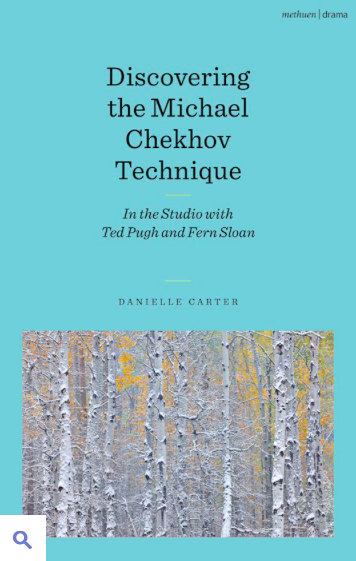
The book is now available!
Order your book directly from the publisher HERE.
 michaelchekhovschool